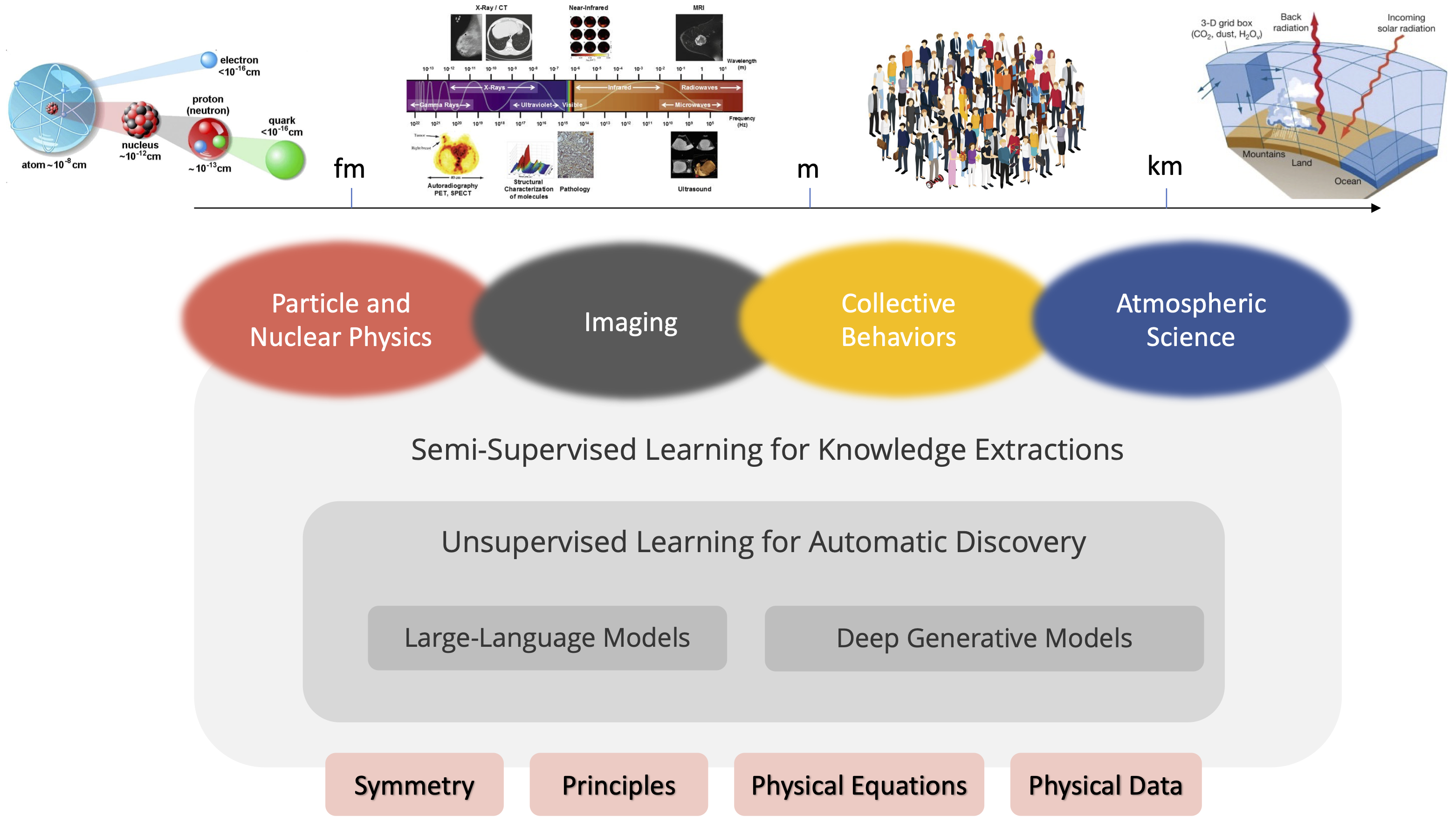
My research operates at the bidirectional frontier of Theoretical Physics and Artificial Intelligence. I develop AI architectures rooted in physical laws to solve fundamental problems in quantum field theory, while simultaneously using statistical mechanics to decode the “black box” of deep learning.
A. Generative Models for Lattice Field Theories
We design physics-conditioned generative models that respect the symmetries of quantum field theory, enabling high-precision sampling that was previously computationally prohibitive.
- Diffusion as Stochastic Quantization: We showed that diffusion models are equivalent to stochastic quantization (JHEP 2024), and developed physics-conditioned, gauge-equivariant samplers for U(1) and non-Abelian gauge fields (JHEP 2026; arXiv:2601.19552). The same approach extends to sampling near criticality in two- and three-dimensional scalar theories (arXiv:2607.08505).
- Neural Path Integrals: We introduced Fourier-flow models for Feynman paths (PRD 2023) and continuous-mixture autoregressive networks for the Kosterlitz–Thouless transition (CPL 2022).
B. Inverse Problems in Physics
Inverse problems such as spectral reconstruction are notoriously ill-posed. We use automatic differentiation and physics-driven neural networks to regularize them (Nat. Rev. Phys. 2025).
- Hadron Physics: We decode hadron–hadron interactions and emitting sources with deep networks (Commun. Phys. 2026).
- Neural RG: We solve functional renormalization group flows and Wilson–Fisher fixed-point equations with physics-informed neural networks (PRD 2026).
- AD-based Reconstruction: We reconstruct spectral functions from lattice data (PRD 2022) and rapidly rotating neutron-star observables from the equation of state (arXiv:2604.05428).
C. AI for Complex Systems
We generalize these methods to broader scientific challenges, from climate patterns to epidemiological dynamics.
- Atmospheric Science: We developed all-weather retrieval models for cloud properties from geostationary satellites (npj CAS 2025).
- Epidemiology: We applied machine learning to predict county-level COVID-19 risk in Germany (MLST 2021).
Awards and Honors
- Sep. 2026: Google TPU Builders Research Award, Google.
- Dec. 2024: Best “Physics for AI” Paper Award, Machine Learning and the Physical Sciences workshop, NeurIPS 2024 & Apple Inc. Higher-order cumulants in diffusion models.
- Jun. 2020: Yu-Hsun Woo Nominee Prize, Dept. of Physics, Tsinghua University & Hung Yin Hua Guan Foundation.
- Nov. 2018: National Scholarship for Graduate Students, Ministry of Education of China.
- Mar. 2015: Distinguished Graduate, Bachelor, Educational Department of Liaoning Province.
- Nov. 2014: National Scholarship for Undergraduate Students, Ministry of Education of China.